
The Snow Girl was inspired by the Russian fairy tale, The Snow Maiden or Snegurochka (pronounced Snee-gur-ochka).
The roots of this fairy tale stretch far back in time, perhaps even to the ancient Slavic people of Europe who believed forces of nature to be deities and spirits. In The Snow Maiden, I feel echoes of Morana, a Slavic goddess of winter whose death allowed for the rebirth of spring. But it is impossible to be sure of the fairy tale’s exact origins as the earliest versions would have been spoken aloud rather than written down.
For generations the tale of The Snow Maiden would have passed from storyteller to listener around the flickering flames of a village bonfire or the warm hearth of a home. Each storyteller would have their own unique way of telling the tale and every telling would be slightly different. So, The Snow Maiden would have been shaped and changed, moulded by countless storytellers as she moved from person to person and place to place.
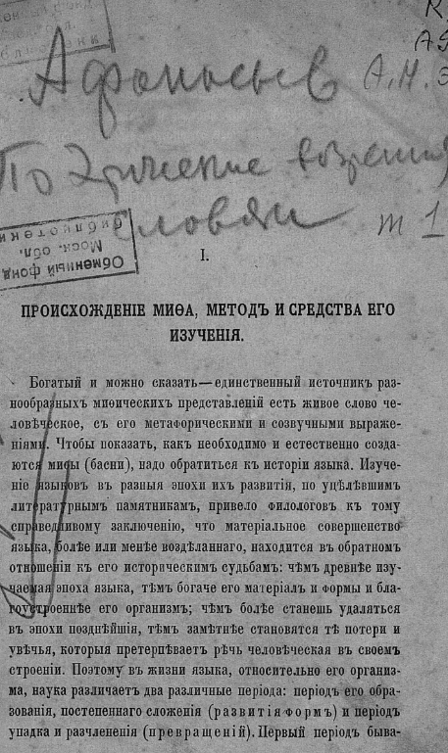
During the mid-nineteenth century, story collectors travelled throughout Russia, often to remote regions, to listen to and write down the traditional tales of storytellers. A scholar named Aleksandr Afanas’ev gathered together and published hundreds of these tales including at least two versions of The Snow Maiden along with a commentary.
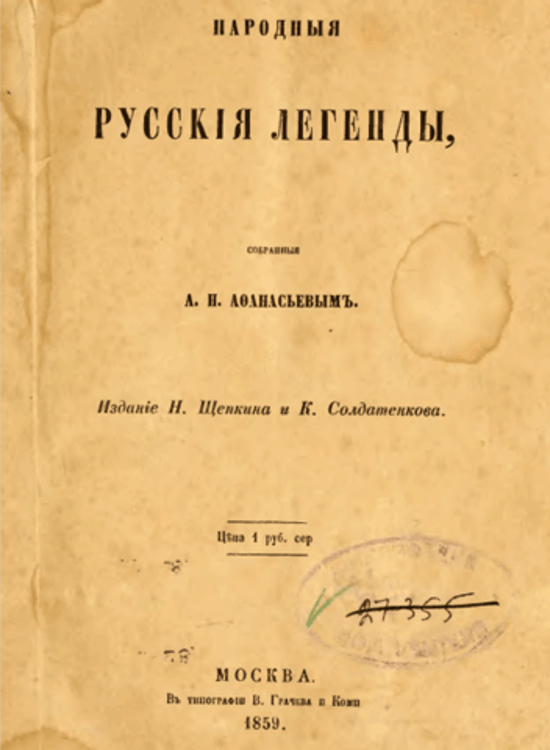
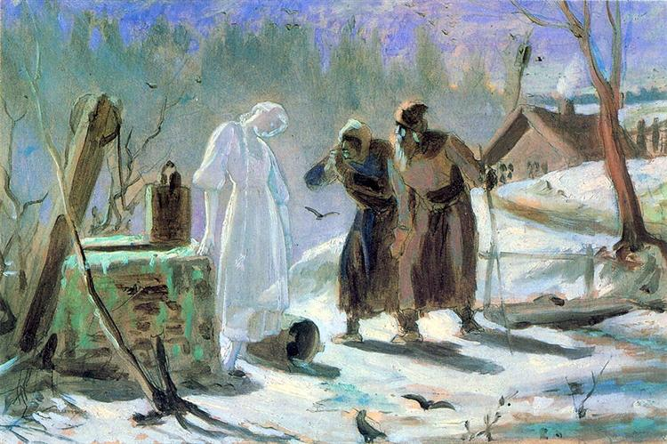
In the simplest version, an old man and an old woman have no children. The old man goes out into the street, makes a snowball, places it on the stove and a beautiful girl appears.
In a longer version of the tale, a couple, Ivan and Marya, live in love and harmony, but are sorry they have no children. One winter, after a great snow fall, the couple build a snow girl who comes to life. The snow girl is happy all winter, but becomes sad once spring arrives. One warm day, she goes for a walk with some friends and they build a bonfire to jump over (this is a traditional Kupala– midsummer festival– activity in many Slavic countries). When the snow girl jumps over the bonfire, she curls into a cloud and flies away into the sky.
Over the next few decades this version of The Snow Maiden was published in many books, often illustrated by talented artists, both in Russia and beyond. English language translations included The Snow Child, in Slavonic Fairy Tales by John Theophilus Naaké (1874); The Snow-Maiden, in Tales and Legends from The Land of the Tzar by Edith M S Hodgetts (1891); and Snowflake, in The Pink Fairy Book by Andrew Lang (1897).
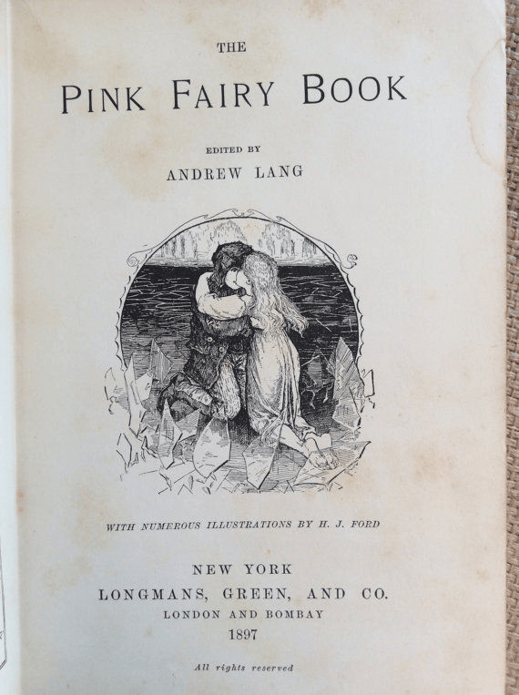
Andrew Lang, 1897
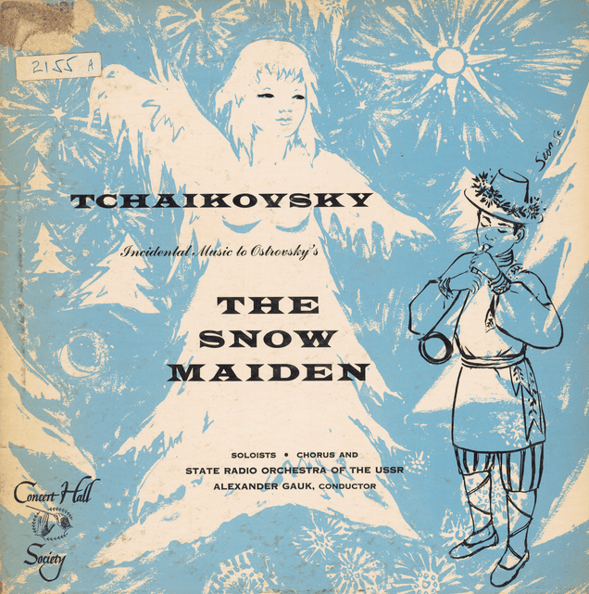
The story also inspired many creative retellings. In 1873, Russian playwright Aleksandr Ostrovsky wrote a play in verse based on the fairy tale which he also called The Snow Maiden, and which the composer Tchaikovsky wrote music for. In the play, the Snow Maiden is the daughter of Mother Spring and Father Frost, and when she falls in love with a shepherd, her heart warms and she melts away.
The play went on to inspire a ballet adaptation in 1878, The Daughter of the Snows, by ballet master Marius Petips and composer Ludwig Minkus. An opera adaptation followed in 1880, The Snow Maiden, by composer Nikolai Rimsky-Korsakov, with sets designed by painter Ivan Bilibin.
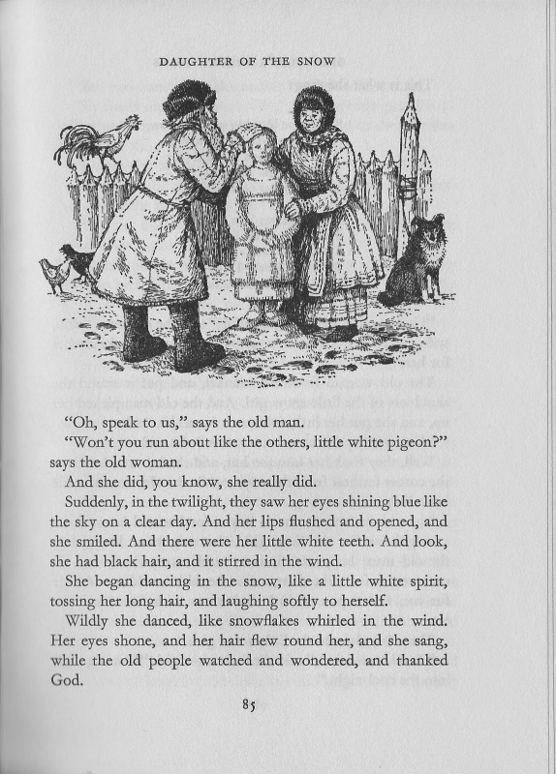
In 1916, English author Arthur Ransome published a slightly different version of the story that included elements from both The Snow Maiden and another fairy tale recorded by Aleksandr Afanas’ev, The Snow Maiden and the Fox. Ransome’s version was called Little Daughter of Snow and appeared in his book Old Peter’s Russian Tales. In the story, an old couple build a snow girl who comes to life and plays and sings all winter. When the weather warms, the snow girl goes into the forest and becomes lost. A fox leads the snow girl home and asks the old couple for a hen as a reward. But instead, the old couple use their dog to scare away the fox. The snow girl sings, “Less you love me than a hen, I shall melt away again,” and disappears, but Old Peter (the narrator of the tale) explains that the snow girl has been carried away, “over the stars to the far north,” where she plays all through the summer and in winter returns to Russia.
This idea of the snow girl being immortal– disappearing in spring, only to reappear in winter– is also touched on by Aleksandr Afanas’ev in his commentary to The Snow Maiden, in his book The Poetic Interpretations on Nature by the Slavs, where he discusses how the story may represent the seasonal cycles of snow fall and melt.
Perhaps the message of The Snow Maiden, if there is one, is about embracing nature’s cycles, as they bring renewal. Or perhaps there is a message of embracing all change, or that love brings change.
The Snow Maiden is such a joyful character in winter– playing, singing and dancing that I always felt the tale contained the message that it is better to live fully, to seek out love and happiness, even if there are risks associated with this– as a short full life is preferable to a long empty one.
But one of the things I love most about fairy tales is how they can mean different things to different people at different times. And since I have become a parent, I have found new meaning in The Snow Maiden. I think perhaps there is another message, that the time we have with our children is fleeting and all too soon they grow up and often move away. So it is important we try to make our time together filled with as much love and happiness as possible.
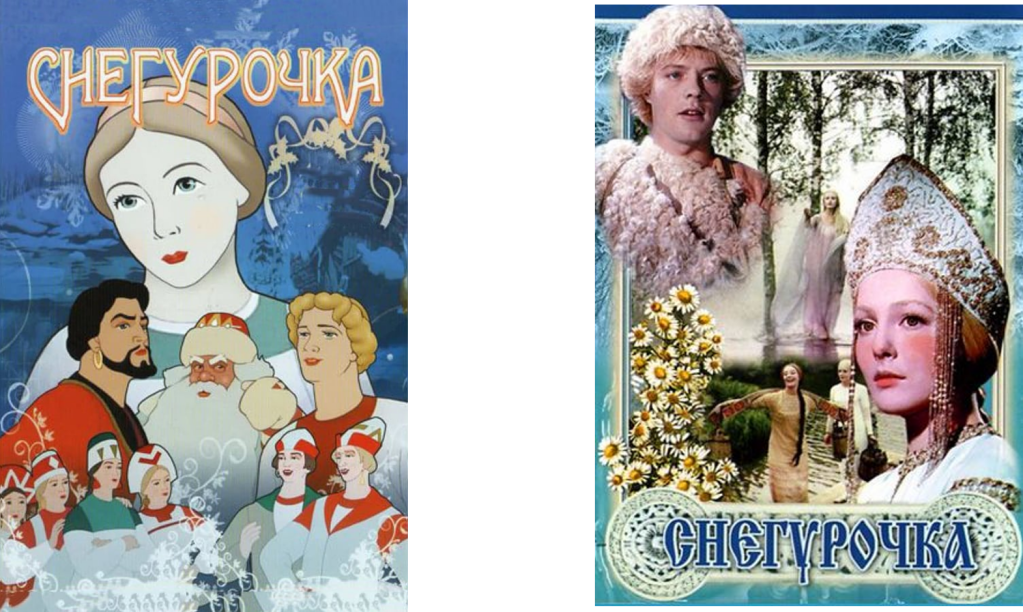
The Snow Maiden has been capturing imaginations for generations and continues to do so today. There are many books, artworks, songs, poems and other creative works that feature her, including a Russian animated film made in 1952 and a live action film made in 1968.
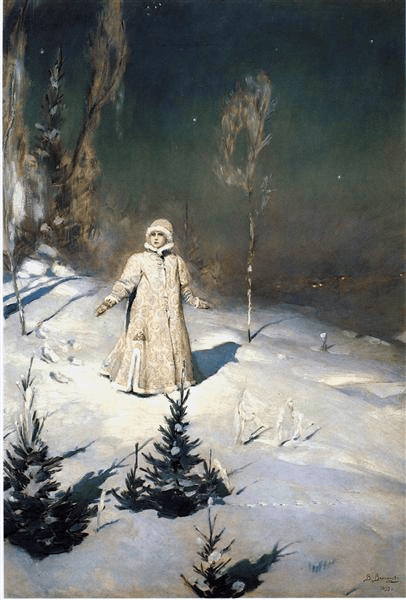
Two of my favourite paintings are Snow Maiden by Victor Vasnetsov, 1899, and Snegurochka by Boris Zvorykin, 1925.
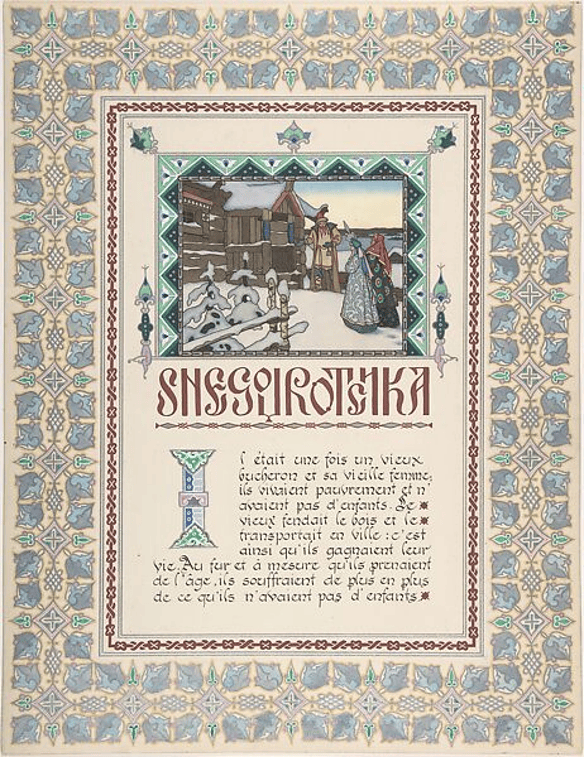
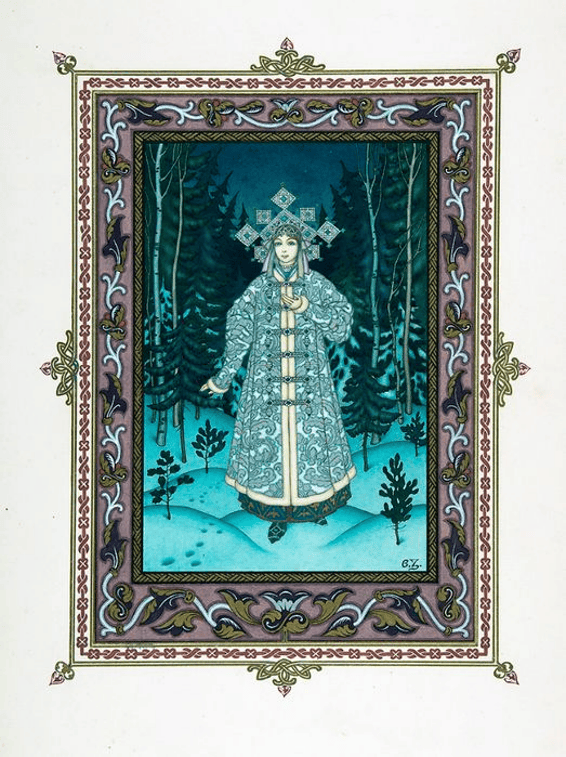
Over the twentieth century, The Snow Maiden has even stepped out of stories altogether to become an important character in some New Year celebrations, helping Ded Moroz– Father Frost– to give out gifts to children.
Like the Snow Maiden, Ded Moroz has his roots in old stories. But over the years he has changed to become a character similar to Father Christmas. Children in Russia sometimes write him letters and on New Year’s Eve he rides in his troika (a sleigh pulled by three horses harnessed side-by-side), wearing a fur coat of blue or red and carrying a long magic stick. He delivers gifts to children who have been good, leaving them under the New Year fir tree. The Snow Maiden, who is sometimes depicted as his granddaughter, at other times a helper, often accompanies him, wearing long blue or white robes and a snowflake crown.
In recent years, The Snow Maiden has continued to inspire creatives and appear in stories, and there are some lovely books to discover that feature her. The picture book The Snow Child written by Freya Littledale and illustrated by Barbara Lavallee (1978) is a beautifully child-friendly version, close to Afanas’ev’s tale, with vibrant illustrations. The picture book The Snow Princess written and illustrated by Ruth Sanderson (2015) roughly follows the story of Ostrovsky’s play, but when the snow princess falls in love, she becomes mortal, rather than melting. And The Snow Child by Eowyn Ivey (2012) is a tender and touching adult novel inspired by the fairy tale, set in 1920s Alaska.
I love the character of The Snow Maiden and all these different versions, retellings and reimaginings that she appears in. To write a book inspired by her has been a wonderful experience and I hope my version of the story honours its past and brings today’s readers joy.
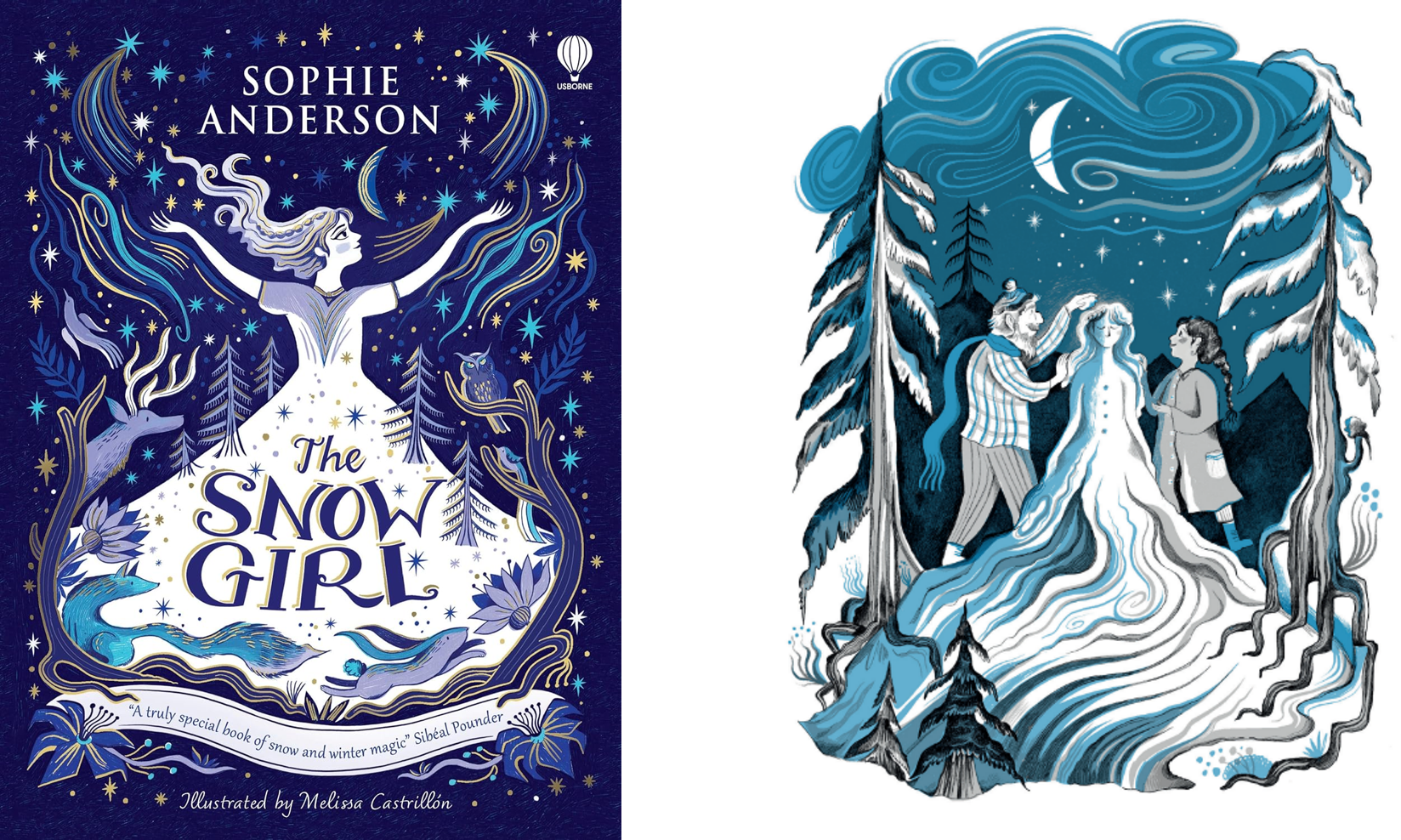
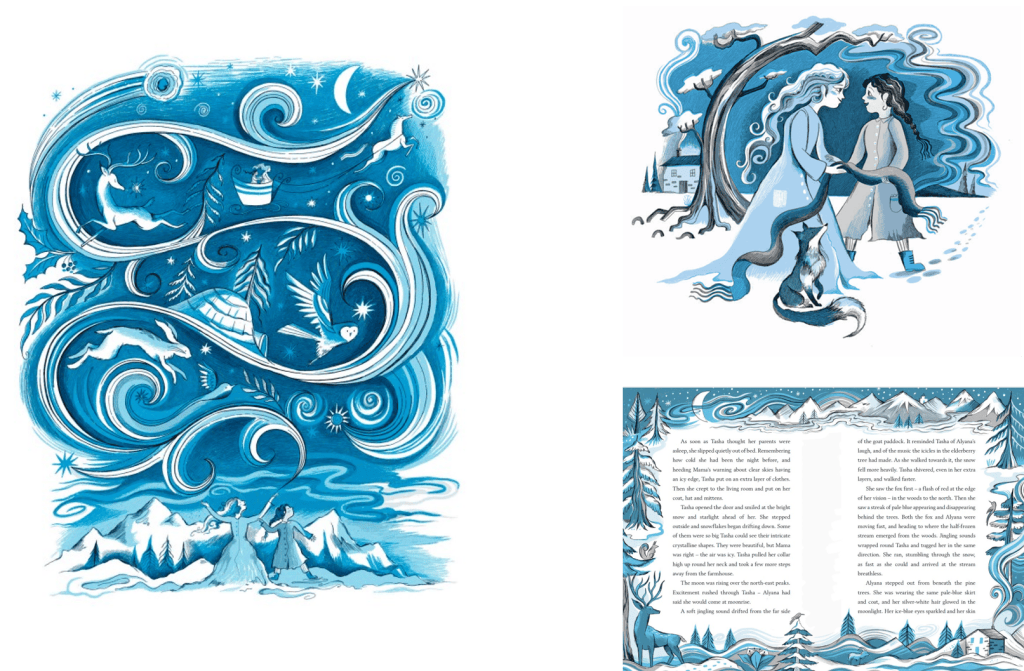
Illustrations for The Snow Girl by Melissa Castrillon, 2023
 Sophie Anderson